Glutes Workout: The Best Exercises to Build Stronger Glutes

Strong glutes power your hips and protect your back. Here’s how to train all three glute muscles for real strength and size.
It can be easy to forget that your muscles serve a purpose beyond looking good once you’ve spent enough time building them up in the gym. Your glutes are a prime example of a muscle group that men, in particular, tend to neglect or fail to isolate because having a bigger butt isn’t always the priority.
Your glutes, however, are the engine of your hips, powering you through sprints, jumps, and exercises like deadlifts. You also need strong glutes to stabilize your pelvis and help keep you upright. So whether you don’t care about your glutes at all or only want to fill out your jeans, there’s more to this muscle group than meets the eye. A smart glutes workout can help you build strength, power, and size at the same time.
TL;DR
An effective glutes workout trains all three glute muscles with a mix of squats, hip thrusts, hinges, lunges, and abduction work. Train your glutes two to three times per week, use a full range of motion, and gradually add weight or reps over time.
Key Takeaways
- A complete glutes workout trains the gluteus maximus, medius, and minimus.
- Squats, hip thrusts, lunges, and other compound exercises should make up the bulk of your glute training.
- Progressive overload and two to three glute-focused sessions per week can help drive strength and muscle growth.
- Strong glutes support hip function, pelvic stability, posture, and everyday movement.
Glute Anatomy: What You’re Actually Training
You know them collectively as your “butt,” but the glutes are made up of three muscles that work closely together and account for a huge amount of muscle mass in your lower body. Together, they help drive your hips forward during everything from sprinting to deadlifting to jumping, while also keeping your pelvis stable as you move. Here’s a quick breakdown:
- The gluteus maximus makes up the bulk of your behind. It’s the largest and heaviest muscle in the body, and it’s responsible for extending your hips, rotating your thighs outward, and helping keep your body upright.
- Also known as part of the upper glutes, the gluteus medius helps move your leg away from your body, rotates the thigh, and plays an important role in stabilizing your pelvis.
- The gluteus minimus is the smallest of the three muscles. It sits underneath the medius and performs many of the same jobs, including moving the thigh outward and helping stabilize the pelvis.
The Best Glute Exercises
Muscle grows when you repeatedly expose it to enough tension and gradually ask it to do more over time. For the glutes, that means choosing exercises that take the hips through a large range of motion and loading them effectively.
Most lower-body exercises involve some combination of hip extension and knee extension. Hip hinges, such as deadlifts and kettlebell swings, rely heavily on the hips, while squats and lunges involve more movement at both the knees and hips. Plenty of exercises in both categories train your glutes, but the six below put them in a particularly prominent role.
If any of these exercises are new to you, add just one to your current lower-body routine for a few weeks until the movement feels comfortable and fluid. Then, start increasing the weight, reps, or difficulty to keep challenging the muscles. And remember that an exercise only works as well as you can perform it. Prioritize controlled reps and a full range of motion over piling more weight onto a movement you can’t control.
Squat
Almost any variation of the traditional two-legged squat can build your glutes, while also training your quads and improving lower-body strength and mobility. Beginners can start with a light goblet squat before progressing to a barbell front squat or back squat.
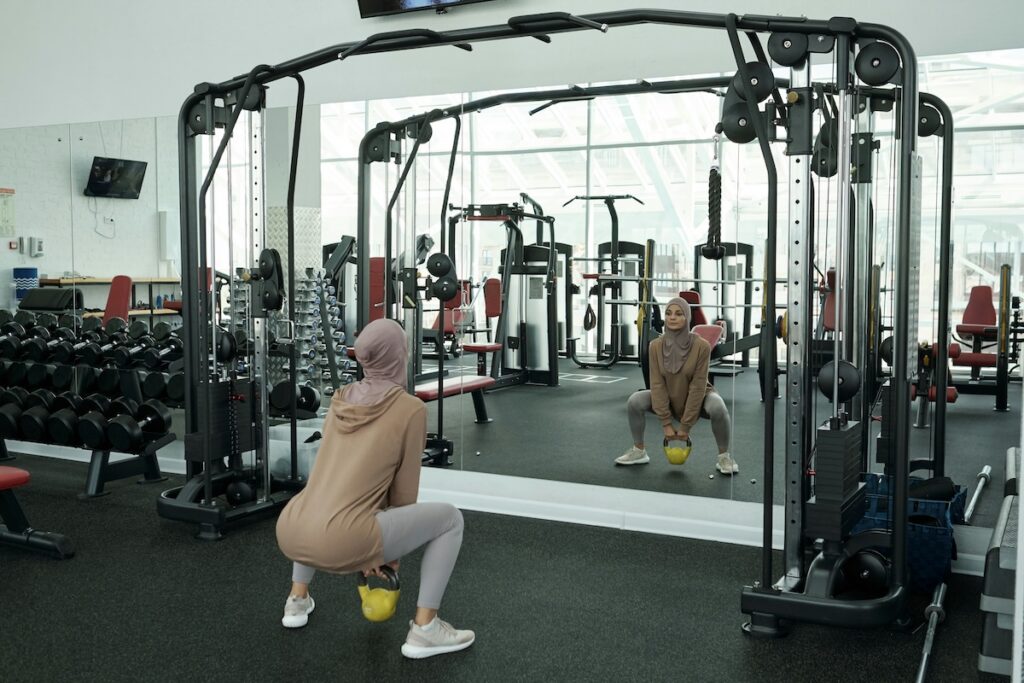
How to Do it:
- Stand with your feet about shoulder-width apart and your toes turned slightly outward.
- Brace your core, keep your chest tall, and sit your hips down and back.
- Lower until your thighs are at least parallel to the floor, or as deep as you can comfortably go while keeping your feet planted.
- Drive through your whole foot to stand back up, squeezing your glutes at the top.
To emphasize the glutes: Squat as deeply as you comfortably can while maintaining good form. A deeper squat puts your hips through a greater range of motion and places the glutes under more tension in a lengthened position.
Romanian Deadlift
The RDL, as it’s commonly called, looks similar to a traditional deadlift, except you typically lower the weight to around the middle of your shins instead of resting it on the floor between reps. Keeping tension on the muscles throughout the set makes the RDL an excellent exercise for the hamstrings and glutes. You can also perform it with kettlebells or dumbbells.
How to Do it:
- Stand with your feet about hip-width apart while holding a barbell, dumbbells, or kettlebells in front of your thighs.
- Slightly bend your knees, brace your core, and push your hips backward.
- Lower the weight along your legs until you feel a strong stretch in your hamstrings and glutes, usually around mid-shin.
- Drive your hips forward to return to standing, keeping the weight close to your body throughout the rep.
To emphasize the glutes: As you lower the weight, think about pushing your butt toward the wall behind you while keeping the weight close to your legs. This encourages a stronger hip hinge and gives your glutes a bigger stretch at the bottom of the rep.
Front Foot-Elevated Split Squat
The split squat trains both the quads and glutes. However, elevating your front foot onto a plate or small platform lets you sink deeper into the rep and increases the range of motion at the hips, making the glutes work even harder. This exercise will challenge your balance, so start with light weight — or even just your body weight — to get comfortable with the movement before increasing the load.
How to Do it:
- Place one foot on a low plate or platform and step your other foot several feet behind you.
- Keep most of your weight over your front leg and lower your body by bending both knees.
- Descend as far as you comfortably can while keeping your front foot flat and your torso controlled.
- Drive through your front foot to return to the starting position, then complete all your reps before switching legs.
To emphasize the glutes: Let your front knee and hip bend deeply while keeping your front foot planted. You can also slow the lowering portion of the rep to about three seconds to make a lighter weight feel significantly harder.
Hip Thrust Machine
A hip thrust machine — plate-loaded or pin-loaded — directly loads hip extension and allows you to train your glutes without worrying much about balance or setup. That makes it especially useful when you want to push a set hard and progressively increase the load over time. If building bigger, stronger glutes is your primary goal, hip thrusts are worth making a regular part of your program.
How to Do it:
- Sit in the machine with your upper back supported and position the pad or belt securely across your hips.
- Plant your feet firmly on the platform with your knees bent.
- Brace your core and drive through your feet to extend your hips upward.
- Squeeze your glutes at the top without excessively arching your lower back, then lower the weight under control.
To emphasize the glutes: Position your feet so your shins are roughly vertical at the top of the rep. If your machine allows it, slightly elevating your feet (on a plate or pair of yoga blocks) can increase the available range of motion. Just make sure the setup still allows you to move comfortably and maintain control throughout the rep.
Cable Pull-Through
The pull-through is the same movement as an RDL, but the cable creates tension through the full range of motion compared to a traditional RDL where it’s heaviest at the bottom. Make sure you start the rep with the weight off the stack, and give yourself enough space so it’s never resting throughout the set.
How to Do it:
- Attach a rope handle to the lowest setting on a cable machine and stand facing away from the stack.
- Grab the rope between your legs and step forward until there is tension on the cable.
- Keep a slight bend in your knees and push your hips backward as the rope travels between your legs.
- Drive your hips forward and squeeze your glutes to return to standing.
To emphasize the glutes: Nowadays, you’ll hear a lot about emphasizing the “loaded stretch” position of an exercise, which, for the cable-pull-through, is the bottom of the rep. There’s merit to that claim, but take advantage of the cable tension by squeezing your glutes at the top of the rep and really feeling the tension.
Machine Abduction
The abduction machine is one of the few exercises that trains the glutes by directly pushing the legs outward, primarily targeting the gluteus medius and minimus. The nice thing about this machine is that you can push a set close to failure without worrying about getting pinned under a weight; when you’re done, simply bring your legs back together and return the stack.
How to Do it:
- Sit in the machine with your back supported and position the pads against the outside of your knees.
- Plant your feet securely and brace your core.
- Push your knees outward against the pads as far as you comfortably can.
- Pause briefly, then slowly bring your legs back together to return the weight to the starting position.
To emphasize the glutes: Push your knees outward against the pads as far as you comfortably can, pause briefly, and return to the starting position under control.
A Sample Glutes Workout
The workout below is a complete lower-body routine that places extra emphasis on your glutes. Perform it once per week, ideally with at least one day of rest before and after. Choose a weight that leaves you feeling like you could complete another two to three quality reps at the end of each set. If you consistently have more than that left in the tank, increase the weight slightly.
Machine Hip Thrust: 4 sets of 6-10 reps
Front Foot-Elevated Split Squat: 3 sets of 8-12 reps (each leg)
Seated Hamstring Curl: 2-3 sets of 10-15 reps
Cable Pull-Through: 2-3 sets of 10-15 reps
How to Grow Your Glutes Faster
- Use progressive overload. This is the principle of doing a little bit more over time so you’re continually challenging your muscles to grow bigger and stronger. Add a few pounds, squeeze out another rep, or improve your control from one workout to the next. It doesn’t have to be a monumental increase to be effective.
- Lift through a full range of motion. Taking an exercise through the largest range of motion you can comfortably control can place the muscle under greater tension, particularly in a stretched position. It can also help you maintain the mobility needed to move well through that range.
- Eat enough protein. Protein supplies the amino acids your body uses to repair and build muscle tissue. The 2025 Dietary Guidelines for Americans recommend aiming for roughly 1.2 to 1.6 grams of protein per kilogram of body weight per day.
- Give your glutes time to recover. More training isn’t always better. Your muscles need time between hard workouts to recover and adapt, so avoid hammering your glutes hard every day. For most people, leaving at least a day between challenging glute sessions is a good place to start.
Frequently Asked Questions
There isn’t just one. You want a workout that includes a mix of exercises that train the glutes through different movement patterns and ranges of motion. Hip thrusts, squats, Romanian deadlifts, split squats, and abduction exercises are all strong options. Focus less on finding one “perfect” exercise and more on progressing several effective movements over time.
Two to three times per week is a good frequency to aim for, provided there’s enough rest time between sessions. You don’t need to crush them every workout, either. Even one dedicated glute-focused workout combined with other lower-body training can be enough to make progress.
Yes, especially if you’re newer to strength training. Body-weight squats, split squats, lunges, single-leg glute bridges, and hip thrusts all work the glutes. Eventually, though, you’ll need to make the exercises harder by adding resistance, increasing reps, slowing the tempo, or progressing to more difficult variations.
There’s no universal timeline, since your starting point, training history, genetics, diet, and consistency all matter. You may notice strength improvements within a few weeks, while visible muscle growth generally takes longer. The better approach is to track your lifts and measurements over several months rather than judging progress workout to workout.
Bottom Line on Glute Workouts
Instead of hitting your glutes with every exercise you know and see on Instagram, train them hard with just a handful of effective exercises, like squats, hinges, hip thrusts, and abduction work. Then gradually increase the challenge over time. Make sure you’re getting enough protein and recovery, and stronger — and potentially bigger — glutes should follow.
Experts Who Contributed
- Andrew Gutman, NASM-CPT, wrote this article.