A Dietitian Says This Is the Best Protein for Aging Muscles

Muscle loss is hard to avoid as you age, but eating enough high-quality protein can help you stay strong, mobile, and independent.
As we age, our strength and muscle mass inevitably decline — by approximately three percent and one percent per year, respectively, according to one review published in 2019. You may think muscle is mainly for gym bros chasing bigger pecs, but muscle tissue does far more than fill out a T-shirt. It moves and supports your joints, helps keep you steady and able-bodied, and may even be a relatively strong predictor of longevity.
In other words, holding on to your muscle as you age should be a priority. Doing that requires regular strength training and enough protein. That’s the macronutrient your body uses to build and repair muscle, along with your cells, hair, nails, and other tissues. But not all protein sources affect muscle in exactly the same way. Complete proteins provide all nine essential amino acids, including the ones most directly involved in stimulating muscle growth. And according to one dietitian, a familiar supplement may be especially useful for maintaining muscle as you age.
What You Should Know About Protein and Aging Muscle
Registered dietitian Jillian Kubala points to whey protein as one of the best options for maintaining muscle with age. Whey is a complete protein, meaning it contains all nine essential amino acids. Those are the building blocks of protein that your body cannot produce on its own. It also delivers a substantial amount of protein for relatively few calories and is easy to mix into a shake, smoothie, or meal.
That combination of nutritional value and convenience can make whey especially useful for older adults who have a smaller appetite or little desire to prepare protein-heavy meals from scratch. Protein provides the raw material your body needs to repair and build muscle, while strength training gives it a reason to do so.
Muscle loss with age is not caused by one factor alone. People often eat less protein and become less active over time, while age-related changes also make the body somewhat less responsive to both protein and exercise. Eating enough high-quality protein and continuing to resistance train can help counter those effects at nearly any age.
Going Deeper: Why Whey, and How Much You Need
Amino acids are organic molecules that create the protein your body needs to build muscle, sure, but also perform hundreds of other bodily processes. Your body needs 20 amino acids to function, and of those 20, nine are considered “essential,” meaning your body needs them but can’t create them on its own. You can obtain these amino acids only from food or supplements.
Almost any whey protein supplement you purchase will contain all nine essential amino acids. Whey is also particularly rich in the three branched-chain amino acids, or BCAAs: leucine, isoleucine, and valine. The body burns through BCAAs right in the muscle, and their distinctive branched structure makes them especially important for building new muscle and repairing it after a workout.
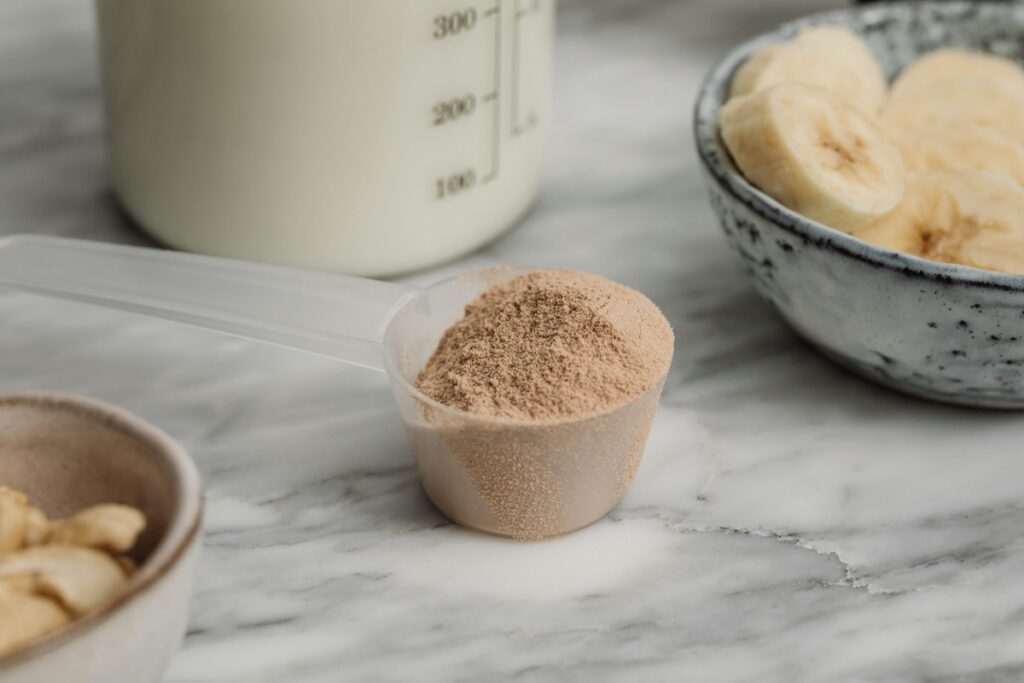
Whey’s amino acid profile isn’t its only advantage. It’s also digested relatively quickly, meaning those amino acids enter your bloodstream and become available to your muscles faster than they would with many other protein sources. Leucine is especially important here because it helps flip the switch on muscle protein synthesis — the process your body uses to repair and build new muscle tissue. Research supports this.
- A 2020 review found that whey protein may promote muscle protein synthesis, improve muscle performance, protect against age-related muscle loss, and even reduce fall risk in adults over 65.
- A 2024 review found that combining whey protein with resistance training improved muscle mass and strength in older adults with sarcopenia.
- And a 2026 review found that pairing whey with resistance training produced some of the most meaningful improvements in muscle and strength.
As for how much protein you need, the old recommended daily allowance (RDA) of 0.8 grams per kilogram (about 0.36 per pound) is really just the floor to prevent deficiency — most adults benefit from more. The 2025-2030 Dietary Guidelines for Americans now put the healthy range at 1.2 to 1.6 grams per kilogram (0.54 to 0.73 per pound); for a 150-pound person, that’s about 81 to 110 grams a day, and anyone trying to hold onto muscle or living an active life should aim toward the top of that range.
Older adults have specific targets. Experts recommend at least 1.0 to 1.2 grams per kilogram (about 0.45 to 0.54 grams per pound) — well above the RDA — just to preserve muscle. Those actively building, recovering from illness, or at risk of malnutrition may need 1.5 to 2 grams per kilogram (about 0.68 to 0.91 per pound) — about 102 to 136 grams a day for that same 150-pound person.
The Takeaway
Whey protein is a convenient, easy-to-absorb supplement that can help older adults reach higher protein targets, especially when appetite or meal preparation becomes a barrier. But the supplement works best when it’s paired with resistance training. Protein provides the raw materials, and the workout puts them to use to build muscle mass. Whole-food and plant proteins still count, too; whey is simply one convenient option.
Bottom Line
Whey is a complete, leucine-rich, and research-backed supplement for helping older adults preserve muscle, particularly when combined with strength training. Still, it’s not magic, and it’s not the only quality protein that works. Total daily protein intake and consistent resistance training are the real drivers of muscle retention, which matters for staying strong, mobile, balanced, and independent as you age.
Experts Who Contributed
- Andrew Gutman, NASM-CPT, wrote this article.
- Lauren Keary, NASM-CNC, reviewed this article for accuracy.