The Best Water Filters for Microplastics

Deciphering which water filter types actually catch microplastics, and which are oversold.
When you reach for a tall glass of water, you should be able to relax knowing you’re staying hydrated, not stress out over fear of microplastics you can’t see. Despite most filters being made with plastic, they remain the best way to rid your water of microplastics. While impossible to avoid plastic altogether, it’s certainly possible to significantly minimize your beverages’ exposure to them.
Microplastics are particles smaller than five millimeters. That’s too small for the naked eye to see but not too small for the best water filters to catch. Let’s break down how the strongest filters are designed and which ones on the market are best for the job.
A good filter is a strong start, but it only covers your water. Our Microplastics Toolkit maps every major source of exposure — food, water, air, and more — with the science-backed swaps that actually cut it down.
Do Water Filters Remove Microplastics?
Setting the baseline, both bottled water and tap water are at risk of exposure to microplastics, and a high-quality water filter is the solution.
Bottled water’s risk comes largely from the bottle itself, which can leach particles into the water it’s holding depending on temperature (heat is the biggest offender), storage time, travel logistics, and more.
You’re more likely to ingest upwards of double the number of particles via bottled water than tap, and unfortunately, reusable plastic water bottles aren’t much better than their single-use counterparts, since they’re vehicles for not only microplastics, but also all the substances they are mixed with, cleaned with, and so on.
The best solution remains: a robust water filter, which could remove 90+% of microplastics. Not all water filters are equally effective, though, and their marketing can be deceptive. Filters that are marketed with the ability to improve water’s taste or remove chlorine and the like does not necessarily mean that they filter microplastics. Actual point-of-use filtration has been shown to remove 94–100% of polyethylene terephthalate (PET), a commonly used plastic associated with a range of health symptoms when ingested in high quantities, and 78–86% of polyvinyl chloride (PVC), another common plastic that’s potentially carcinogenic.
Going Deeper: Which Filters Actually Work
Here are the filter types that matter for microplastics, ranked from most to least effective:
Reverse Osmosis
Reverse osmosis is a water filtration process that uses an external force to push water through a semipermeable membrane so that the filter can catch contaminants larger than what the membrane allows.
Reverse osmosis is exceptional for filtering microplastics, catching nearly 99% of microplastics thanks to membranes with pores as small as 0.001 microns. If you have access to a filtration system that uses reverse osmosis, it is probably your best bet against microplastics.
No reverse osmosis membrane will be plastic-free since they are built with plastic, so remain vigilant about following the filter’s required maintenance schedule to ensure it continues to function properly, and store the filtered water in glass or stainless steel.
Two solid picks: the AquaTru Glass Carafe for a countertop system, or the APEC RO-90 if you want an under-sink setup. And if you’d rather have reverse osmosis built into your whole house than filter one tap at a time — or you’re on well water — Leaf Home Water Solutions will test your water for free and install a whole-home system for you.
Membrane Microfiltration and Ultrafiltration Filters
If a full reverse osmosis system isn’t practical — say you’re renting — a membrane-based pitcher or countertop unit is your next best bet. These use a physical barrier with pores fine enough to strain out particles, which is exactly what caught 78–100% of tested plastic fragments in the point-of-use study above. Performance hinges on pore size and an intact membrane, so follow the replacement schedule and don’t push a cartridge past its rated capacity.
Picks: the gravity-fed ProOne Big+, or Crystal Quest’s microplastics-specific line if you want a unit built around particle removal.
Carbon Filters
Carbon filters use a process called adsorption — porous charcoal that traps certain contaminants as water passes through. They shine at improving taste and cutting chlorine, odors, and some dissolved chemicals, but they shouldn’t be oversold as microplastic filters. Whether they catch particles depends on the physical design, not just the carbon: a dense carbon block may trap some, while loose granular carbon is far less reliable, especially for the smallest particles.
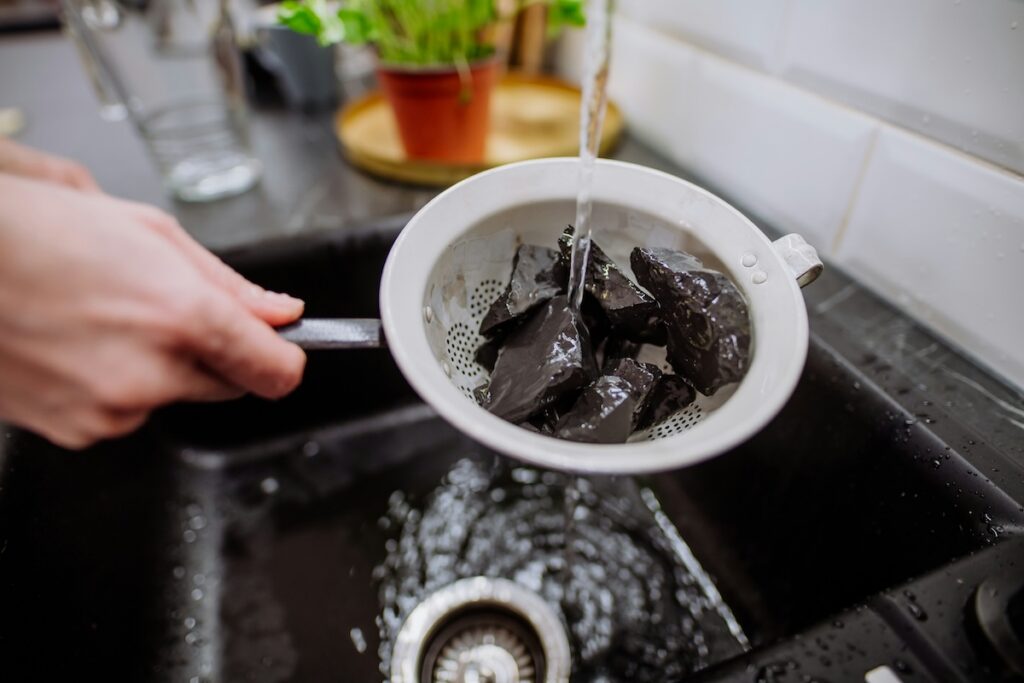
Treat carbon as a taste-and-chemical upgrade, not your main microplastic barrier. If it’s your only option, be diligent about cleaning to prevent bacterial accumulation — everything the filter captures has to go somewhere, and better the trash than your body.
If you want carbon done well, the Multipure uses a dense carbon block in a stainless-steel housing rather than loose granules.
Does a Brita Filter Microplastics?
Not reliably. A standard Brita-style pitcher runs water through granular activated carbon and an ion-exchange resin — great for taste, chlorine, and some metals, but not built to strain out microplastics. In the point-of-use study, the device that relied only on carbon and ion exchange was the weakest of the bunch; at times it put more PET particles out than went in, likely from the media shedding. If microplastics are your concern, reach for a membrane or reverse osmosis system instead — a Brita is a taste upgrade rather than a microplastic barrier.
Store It Right: Where Your Filtered Water Goes
Filtering is only half the job — the moment purified water sits in a plastic pitcher or tank, it can pick particles back up. So route filtered water straight into glass or stainless steel. Reusable bottles made of glass or stainless steel won’t diffuse plastic into your water since they don’t contain any. If using the latter, be sure the interior is uncoated 18/8 food-grade, and don’t blunder that wonderfully microplastic-free environment by using plastic straws, valves, lids, or caps.
Your bottle cap could undo a lot of the work that your otherwise plastic-free bottle is doing. Microplastic contamination increases as you open and close a bottle with a plastic cap.
The Takeaway
Ultimately, a reverse osmosis system — or another membrane-based filter — gives you the most thorough microplastic removal. A carbon filter is worth having for taste and chlorine, but don’t count on it as your primary microplastic barrier. Whichever you choose, route the filtered water straight into glass or stainless steel so it stays microplastic-free.
Bottom Line
A reverse osmosis filter is your best bet since it will most reliably remove the most microplastics from your water. It just requires the added effort of maintaining and cleaning the system routinely. For specific models, our top reverse osmosis picks are the AquaTru Glass Carafe (countertop) and the APEC RO-90 (under-sink).
Dialed in your water filter? Take it further. Our Microplastics Toolkit gives you a personal exposure audit and a step-by-step action plan to lower your microplastic exposure across your whole home.
Experts Who Contributed
- Lauren Keary, NASM-CNC, reviewed this article for accuracy.