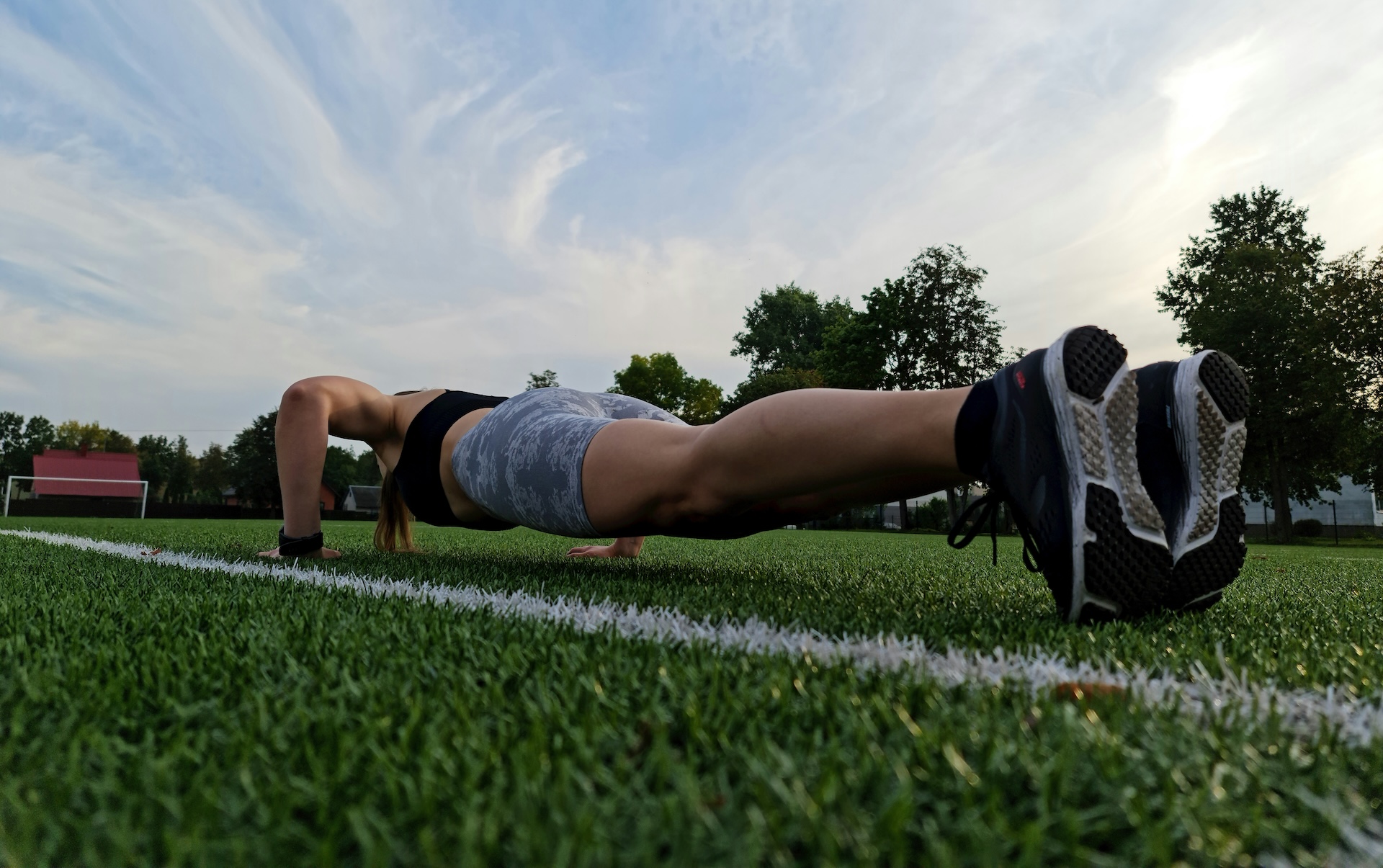
How Many Push-Ups Should You Be Able to Do at Your Age?

Push-up ability changes with age, body weight, and training history. See how your max compares with standard benchmarks, and learn how to build it.
Quick answer: Using American Council on Exercise benchmarks, an excellent push-up score is 36 or more for men in their 20s and 30 or more for women, dropping by about three to six reps each decade after that. These represent the top tier of the assessment, so landing below them is common — and body weight and training history shape your number more than age does.
Most people have no idea whether their push-up count is impressive, average, or needs work. The answer depends on your age, sex, body weight, training history, and overall fitness, but the benchmarks below top out at 36 reps for men in their twenties and 30 for women, dropping steadily from there with each decade. Knowing how many push-ups you should be able to do by age can give you a useful benchmark — and a clear number to improve upon.
Push-ups are a fantastic strength-training exercise that builds your chest, shoulders, triceps, and core without equipment, making them an accessible way to increase upper-body strength and maintain muscle as you age.
Your Push-Up Numbers by Age
Note: Women completed the assessment from the modified, knees-on-the-ground position, and ACE didn’t assess people over 69 years old. If you’re in that group, the goal shifts from hitting a benchmark to holding onto what you’ve got — strength training at least twice a week helps preserve muscle.
| Age | Men: Excellent | Men: Room to Improve | Women: Excellent | Women: Room to Improve |
|---|---|---|---|---|
| 20-29 | 36 or more | 16 or fewer | 30 or more | 9 or fewer |
| 30-39 | 30 or more | 11 or fewer | 27 or more | 7 or fewer |
| 40-49 | 25 or more | 9 or fewer | 24 or more | 4 or fewer |
| 50-59 | 21 or more | 6 or fewer | 21 or more | 1 or fewer |
| 60-69 | 18 or more | 4 or fewer | 17 or more | 1 or fewer |
The benchmarks above come from the push-up assessment protocol used by the American Council on Exercise (ACE), which adapted them from the Canadian Society for Exercise Physiology. They are general fitness guidelines, not medical standards or a final verdict on the state of your health. Use them as a ballpark to gauge your current upper-body endurance and as motivation to keep practicing one of the most accessible all-around strength exercises.
What Actually Shapes Your Push-Up Number
Strength and muscle endurance are moving targets. Both tend to decline with age, but where you sit on the calendar is only part of the equation. Resistance training — any exercise that challenges your muscles against an external load — can improve strength, muscle mass, and endurance at virtually any age.
Beyond age-related changes in muscle and endurance, your activity level, training history, body weight, and overall size matter a ton. Push-ups are a test of relative strength. Since you’re pressing your own body, a lighter, more active 60-year-old has a solid chance of smoking a heavier 30-year-old who spends most of the day fused to an office chair. And someone who regularly performs push-ups will be more efficient at them than an otherwise strong person who rarely drops down to the floor. Age, after all, is only one number in the equation.
Why Push-Ups Are Worth Practicing
Push-ups are everywhere, from school gym class tests to police and fire academies to military fitness assessments. That’s partly because they’re free, portable, and simple. You get on the floor and start pressing. But they also reveal something useful about your fitness.
A push-up is a test of relative strength — how well your upper body can move your own body weight. Your chest, shoulders, and triceps produce the force, while your core keeps the rest of your body from sagging to the floor. Knocking out a respectable number of clean reps, based on the benchmarks above, suggests you’ve developed both upper-body strength and muscular endurance.
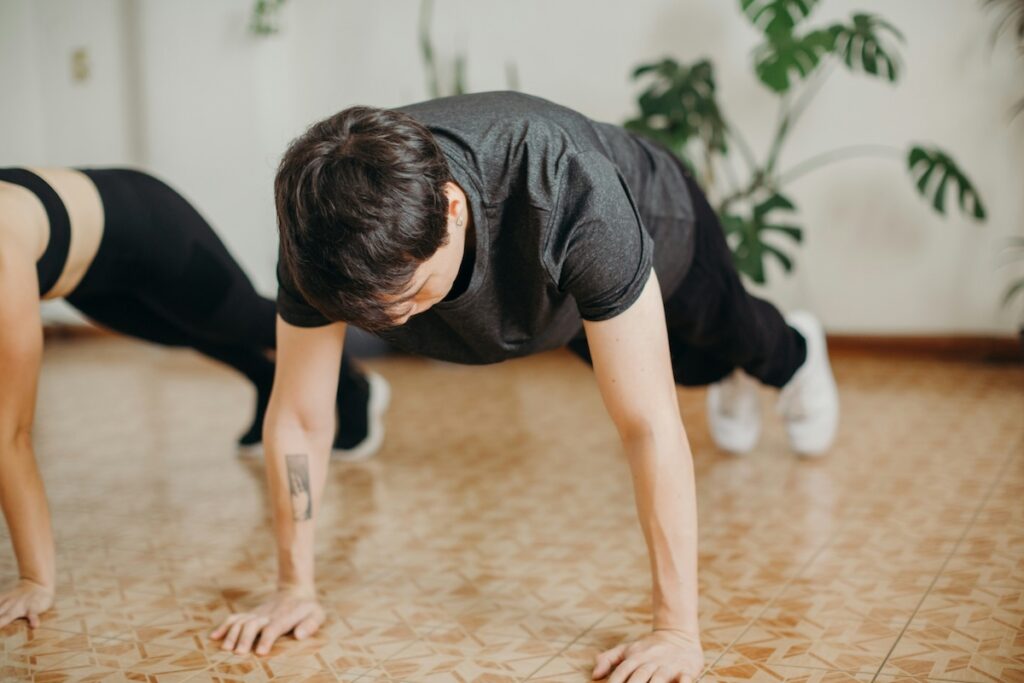
And you don’t need Special Forces ambitions — or even a strong desire to be fit — to benefit from them. As a resistance exercise, push-ups can contribute to a broader strength program that supports bone health as you age. A systematic review of resistance training in older adults found modest improvements in bone mineral density at the hip and spine, which is why loading your muscles and skeleton consistently matters more as you age.
That strength is also practical beyond the gym. It helps when you’re carrying groceries, hoisting a kid, pushing a door, or getting yourself off the floor. You don’t need to be preparing for a powerlifting meet to appreciate being stronger than your daily life demands.
How to Build Your Push-Up Count
Whether you’re working towards your first push-up or your 30th, there are a handful of modifications and techniques you can use to help you get there.
If full push-ups still feel out of reach, start with one of these variations:
- Wall push-ups: Stand a few feet from a wall, place your hands against it, and press your body away from it. Because you’re moving less of your body weight, this is the easiest place to learn the pattern and build confidence.
- Incline push-ups: Put your hands on something stable a couple feet off the ground — a weight bench, a kitchen counter, a solid table. You’ll still practice the same head-to-heels body position as a standard push-up, but with less resistance. As you improve, gradually use lower surfaces.
- Knee push-ups: Performing push-ups from your knees shortens the lever created by your body and meaningfully reduces how much weight your upper body has to press. Keep your hips extended so your torso and thighs form one straight line rather than folding at the waist.
- Partial-range push-ups: Lower yourself only as far as you can while staying in control, then press back up. Over time, work toward a deeper bottom position until you can complete the full range without losing form.
- Push-up bars or dumbbells: Holding handles or a pair of stable dumbbells keeps your wrists in a more neutral position. That can make the movement more comfortable if placing your palms flat on the floor bothers your wrists.
Whatever variation you use, work on a stable, non-slip surface, and stop if you feel sharp or pinching pain in a shoulder or wrist.
Already have a few reps? Use these strategies to build your max:
- Keep your body rigid: Brace your abs and glutes so your torso moves as one piece, with your head in line with your spine. If your hips sag or your chin reaches the floor before your chest, the set is probably over.
- Practice more than once a week: Push-ups are a skill as much as an exercise. Hitting them two to four times a week gives you more chances to sharpen your technique without cramming every rep into one soul-crushing workout.
- Add reps slowly: Trying to double your total overnight is a reliable way to end up painfully sore. Aim to add a rep or two per set, then let those gains settle before pushing the count up again.
- Give hard sessions room to breathe: You don’t need two full days off after every easy set, but giving yourself about two days between demanding upper-body workouts lets your muscles recover before you ask them to perform again.
- Train the supporting cast: Planks can improve trunk control, while triceps pressdowns, dumbbell bench press, and seated rows strengthen the muscles that help you press and stabilize your body.
- Write it down: Track the variation you used, how many sets you completed, and how many clean reps you managed. Progress is easier to spot — and much harder to accidentally exaggerate — when the numbers are staring back at you.
FAQs
ACE’s assessment stops at age 69, where an excellent score is 18 or more for men and 17 or more for women. Past 70, research suggests the more useful goal is maintaining what you have rather than hitting a benchmark. Strength training at least twice a week helps preserve muscle as you age.
Yes, by the benchmarks here. ACE’s excellent threshold tops out at 36 reps for men aged 20 to 29 and drops each decade after that, so 40 clean reps clears the highest tier on the chart. Form matters more than speed — sagging hips turn a rep into a partial.
Using ACE benchmarks, an excellent score is 30 or more push-ups for women aged 20 to 29, dropping to 17 or more by their 60s. Women completed the assessment from the modified, knees-on-the-ground position, so those numbers aren’t directly comparable to the men’s column.
Research on resistance training suggests progressive overload matters more than daily volume. The same 100 reps every day stops challenging your muscles once you adapt. Experts generally recommend hitting push-ups two to four times a week and adding a rep or two per set rather than chasing a daily number.
For men between 40 and 49, the chart puts an excellent score at 25 or more, while nine or fewer signals room to improve. Anything in between is fairly typical. Your number moves with training history, body weight, sleep, and how often you actually press, so it tends to shift more than people expect.
It depends heavily on age and training. For men in their 20s, 25 sits comfortably between the excellent mark of 36 and the 16-or-fewer range that suggests room to improve. For women in their 20s, 25 is close to the excellent threshold of 30. Plenty of untrained adults land well below both.
There isn’t one. Push-ups scale down as easily as they scale up — an incline against a kitchen counter or a drop to your knees both count — and the chart still lists standards through age 69. If a shoulder or wrist issue makes them painful, a clinician or trainer can suggest a modification worth keeping.
The Takeaway
Your push-up count offers an accessible, equipment-free snapshot of your upper-body strength and endurance. It’s also highly trainable at any age, so treat the benchmarks as a useful ballpark, not a final grade on your fitness.
Bottom Line
Push-ups build genuine strength in your chest, shoulders, triceps, and core, while also contributing to the bone benefits that come with regular resistance training. Your current conditioning, body weight, and training history will usually say more about your push-up count than your birth year. Start with a variation you can perform well, practice consistently, and gradually increase the reps.
Experts Who Contributed
- Andrew Gutman, NASM-CPT, wrote this article.
- Lauren Keary, NASM-CNC, reviewed this article for accuracy.