Your Brain May Actually Be Two Separate Organs

All Healthy Design Studio
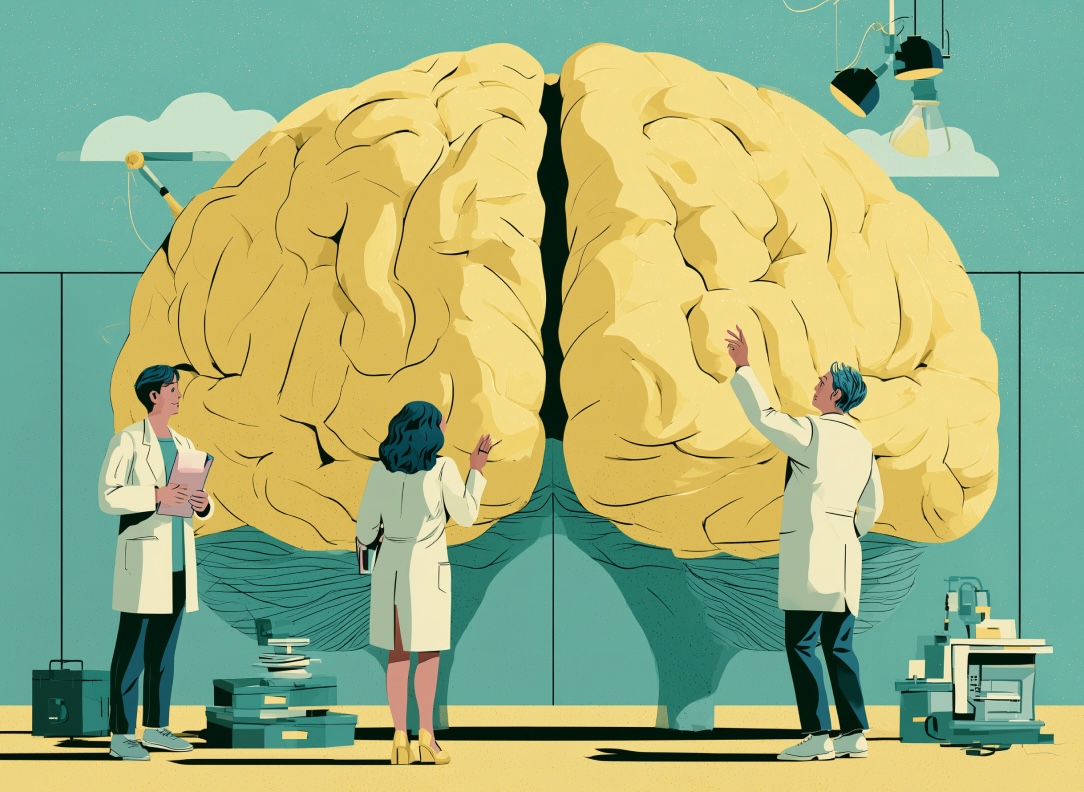
Evolutionary Mash-Up: Your brain may look like one organ — and throughout history, it’s been viewed as such — but new research suggests the human brain is more like two ancient nervous systems that merged through evolution. One of these systems keeps you alive; the other lets you write poetry, solve math equations, and wonder why you’re here.
The Study: Stanford researchers found that the human brain develops from two distinct cellular systems with different evolutionary histories. One produces the hindbrain, an ancient part of the nervous system responsible for essential functions such as breathing and heartbeat. The other produces the forebrain and midbrain, which support complex behaviors and cognition. When studying the early stages of embryonic development, the scientists found that the hindbrain develops along its own distinct pathway, evolving parallel to — not branching from — the pathway that produces the forebrain and midbrain.
The discovery also helped researchers grow human hindbrain motor neurons in the lab — something that has historically been difficult to do. These cells could provide a new tool for studying diseases that affect the brainstem and motor neurons, including ALS and spinal muscular atrophy.
Takeaway: The finding offers a fascinating glimpse into how evolution built the human brain and gives scientists a better way to study some neurological diseases.
Keep in Mind: The two systems are deeply integrated, working together to produce everything from basic life-sustaining functions to complex thought and behavior.