
Could Your Pillow Height Affect Glaucoma? A Small Study Takes a Look

A promising small study found that sleeping on a stack of pillows was linked to higher pressure inside the eyes of people who have glaucoma.
If you’re like us, you’ve likely never thought of the number of pillows you use as a medical decision for your eye health. But research suggests that how high your head rests while you sleep could affect the pressure inside your eyes, and for the 4.2 million Americans living with glaucoma, that pressure number is key. A 2026 study found that sleeping on two pillows was linked to higher eye pressure than lying flat. Though there’s science behind it, we’re still a long way from making this a reason to immediately change up your sleep setup. But more on the preliminary research below.
What You Should Know About Glaucoma and Sleep
Glaucoma is a group of eye diseases where pressure builds up inside the eye and can damage the optic nerve at the back of it. The damage can lead to permanent vision loss, which is why glaucoma ranks among the leading causes of irreversible blindness across the world. The pressure is called intraocular pressure, or IOP, and pretty much all treatments for glaucoma focus on lowering it.
As you get older, your risk for developing glaucoma increases, and CDC data shows women have a somewhat higher prevalence than men, and Black Americans have the highest prevalence of any group tracked. With that in mind, the idea that a simple change in pillow height might shift eye pressure is pretty exciting for patients.
The research that was published in the British Journal of Ophthalmology and summarized by BMJ Group found that a higher sleeping position was associated with higher intraocular pressure in people who already have glaucoma.
Going Deeper on the Glaucoma and Sleep Position Study
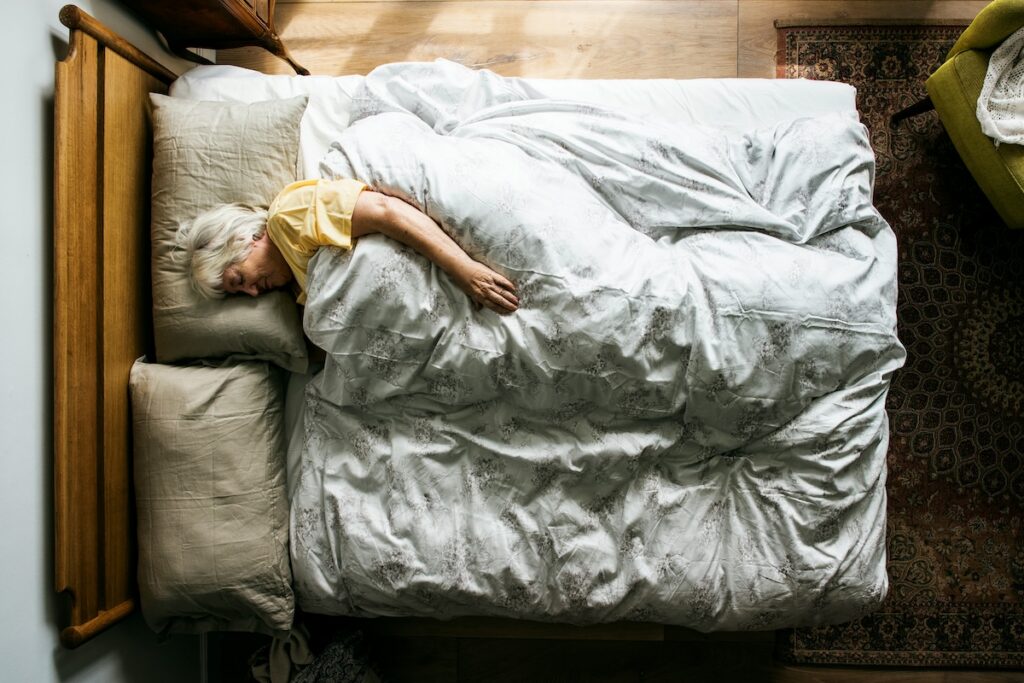
Researchers followed 144 adults with glaucoma and measured the pressure in one eye every two hours for 24 hours, both lying flat and with the head raised 20 to 35 degrees using two regular pillows. After each raised reading, participants went back to lying flat until the next measurement.
About two-thirds of them — 96 people, or 67% — showed a noteworthy jump in eye pressure when they went from flat to propped up. The average increase was small, around 1.61 mmHg (17.42 versus 16.62 mmHg), but it came with a drop in ocular perfusion pressure, the force that pushes blood through the eye’s vessels. Less perfusion pressure means less oxygen and fewer nutrients reaching the eye.
Researchers also used ultrasound on 20 healthy volunteers and saw that the raised position narrowed the jugular veins — the ones that drain blood from the head to the heart — and sped up the blood moving through them. In layman’s terms, these are both signs of the veins being pinched. When neck flexion compresses those veins, the theory goes, it can back up the fluid drainage that keeps eye pressure in check.
But younger adults and people with primary open-angle glaucoma, the most common form, tended to show bigger pressure swings than others. And this is an observational study, so it can’t prove the pillows caused the change. Plus, the number of people in each glaucoma subgroup was small.
The Takeaway
This is an interesting study rather than a cause for alarm — a stack of pillows isn’t going to give you glaucoma. If you already have glaucoma and tend to sleep heavily propped up, it’s fair to ask your eye doctor about this at your next visit.
Bottom Line
In this group of glaucoma patients, sleeping propped up was tied to higher eye pressure and lower perfusion pressure, with jugular compression as the likely mechanism. But the sample was small, the study’s design can’t establish cause and effect, and there’s no evidence yet that changing your pillow setup changes the long-term course of the disease. It’s a promising lead with an easy, drug-free change worth studying. But there’s no need to take action tonight; just ask your doctor about it at your next appointment.