Core Exercises That Help Protect Your Back

Six research-backed moves to stave off injury.
Many mistakenly conflate their core and abdominals as the same thing. Your core comprises the axial skeleton and all soft tissues with proximal attachments originating from it. The abdominals are five major paired muscles on the anterior and lateral walls between the pelvis and ribcage.
Understanding the difference can help identify how to train your core, which helps stabilize your back in ways that only training the abdominals cannot. Doing crunches by lengthening and shortening the abdominals can strengthen those muscles, but they aren’t as effective at protecting your back as core stabilization exercises (CSE). We’ll explain six CSE you can use to strengthen your core, thereby reinforcing the stability of your back. But first…
What You Should Know About the Core and Back Pain
The goal of strengthening your core is to be able to maintain neutral spine alignment while moving extremities to limit unwanted pelvic movement and to transfer load. Essentially, reinforcing your core helps keep your spine less susceptible to compromised positions during movement.
Performing CSE has been shown to be consistently more effective for helping low back pain than general exercise. There are three branches of scalable core exercises to understand: those that promote muscular endurance and neuromuscular control, deep stabilizers that promote neutral spine maintenance, and bracing.
Going Deeper: The Moves
The following six-exercise progression could serve as your simple programming to proactively protect your back. If you already suffer from back pain, consult a physician before performing these exercises.
Muscular Endurance
Curl-Up
Not to be confused with a crunch, the curl-up is part of McGill’s Big Three, a spine-sparing core endurance approach developed by Dr. Stuart McGill, a spine biomechanics professor at the University of Waterloo. The Big Three — the curl-up, the side plank, and the bird dog — build core endurance without loading the spine.
Lie on your back with one knee bent and its corresponding foot flat on the floor and the other leg extended. Place your hands under your lower back. From this position, without altering the neutral position of your spine, engage the abdominals to lift your head and shoulders briefly off the floor. That’s one rep.
The range of motion will be small. Distance off the floor is not the goal. Rather, the aim is to be able to engage your abs without curving or otherwise moving your spine. You can progress this exercise by holding each rep longer.
Side Plank
Also known as the side bridge, the side plank strengthens the lateral core to resist lateral flexion.

While lying on your side, bend your knees to 90 degrees. Then lift onto your forearm so your torso is off the floor (this remains a rest position); your shoulders should stay aligned, and you should face the same direction as your pelvis.
From there, brace your core and lift your hips off the floor while maintaining a neutral spine. Only your elbow, forearm, hand, and knees-and-below should touch the floor. Imagine that during the lift, you are pushing the floor away rather than lifting your body up. To ensure your shoulders and hips remain aligned, remember to engage your glutes to extend the hips.
Sustain this position for 10 seconds and then lower. That’s one rep. You can progress this move by extending the legs so that the side of the bottom foot touches the floor instead of your knee. For stability and balance, place the top foot in front of the bottom foot.
Neuromuscular Control
Bird Dog
On all fours, maintain a neutral spine and extend the left foot by engaging the glutes, quads, and abdominals. Imagine driving your heel to the wall behind you. Simultaneously, reach your right arm forward, flexing your triceps, as though driving a punch through the wall in front of you. Hold for 10 seconds to complete a rep then switch to the opposite limbs.
You can progress your bird dog by drawing shapes with the extended limbs. For example, imagine drawing a circle or a diamond with the extended leg and arm. To improve neuromuscular control, try drawing different shapes with the arm and the leg.
Dead Bug
The dead bug builds anterior-core stability — training your deep core to resist your lower back arching — when it’s executed properly.
Lie in a semi-supine position, lift the knees above the hips until they feel like they could remain there passively. Then, engage your core to bring the knees a few inches closer to your sternum. The target isn’t range of motion but rather to ensure your core is engaged and maintaining your lower back against the floor.
Extend your arms straight to the ceiling. While keeping your core braced, drop one heel at a time to the floor, maintaining your bent knees. Once comfortable with that, reach the opposite hand to the floor above your head, touching your thumb to the floor at the same time as your heel; opposite limbs extend along the same plane.
To progress further, extend the legs as much as you can while maintaining your braced core. This variation will highlight how tight your hamstrings might be pretty quickly.
Deep Stabilizers
Glute Bridge
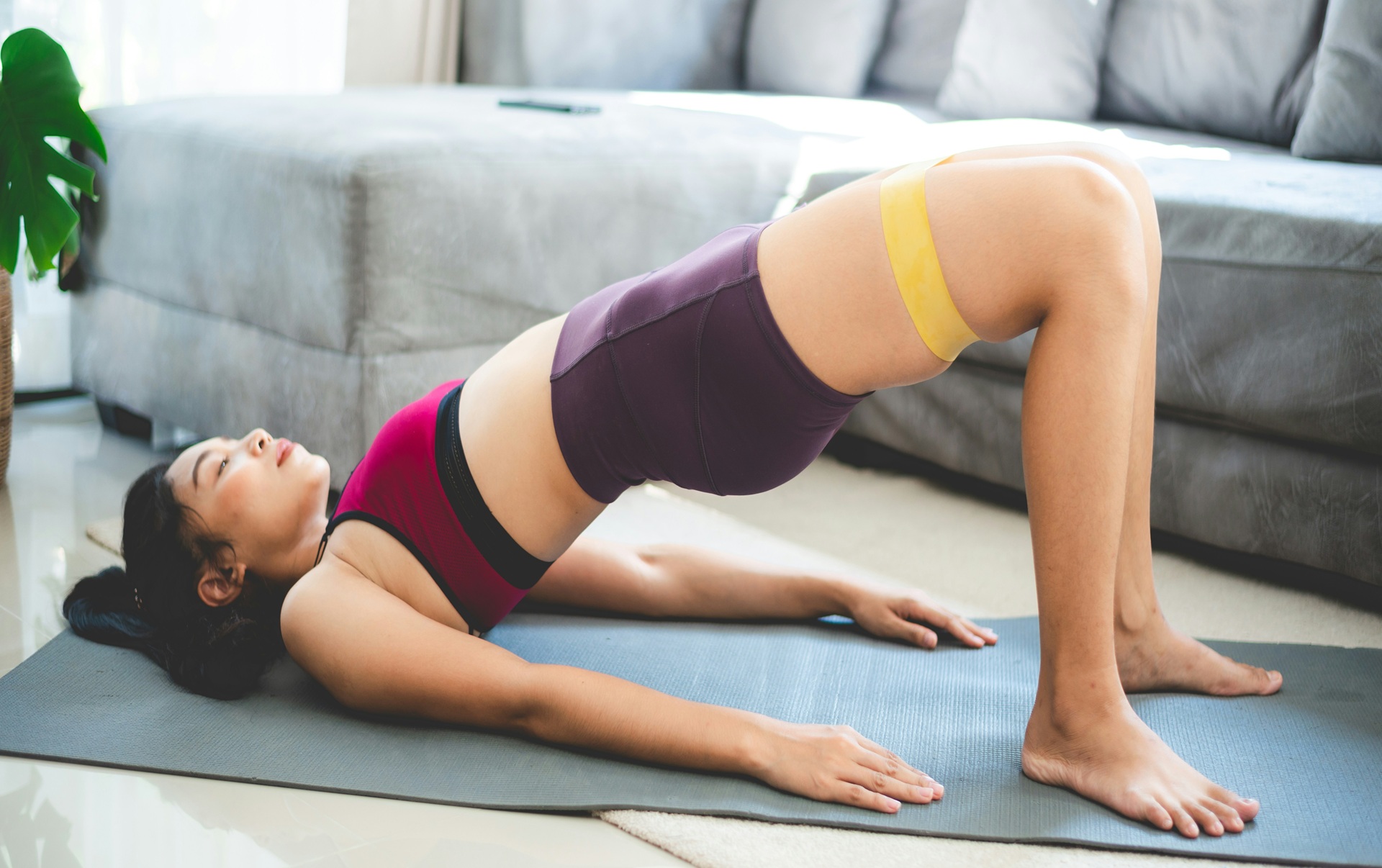
The glute bridge strengthens the glutes and hip extensors that support the pelvis and lower back. Lie in a semi-supine position and extend your arms laterally to provide a comfortable base.
Engage your core similar to the bird dog exercise to touch your lower back to the floor. While maintaining that brace to support a neutral spine, engage the glutes and drive through the heels, extending your hips until your shoulders, hips, and knees are in a straight line.
Control the hips’ descent to the floor without relieving your neutral spine. Go as slow as needed to secure your neutral spine through the entire range of motion. That’s one rep.
You can progress this exercise by lifting one knee off the floor to effectively perform a single-leg glute bridge. This requires your core to resist rotating to maintain a neutral spine. Take your time with this progression, it sounds much easier than it is.
Prone Plank
The classic plank position is a common sight: from a prone position, lift onto your toes and forearms. Where most falter is failing to effectively brace their core or compensating by positioning the forearms to ease the difficulty.
Stack your elbows under your shoulders, brace your core, and drive your heels to the back wall while on the balls of your feet. With your core engaged to maintain a neutral spine, hold this position for 30 seconds or as long as you can. That’s one rep.
To progress the plank, you can place a kettlebell on its side and hold the handle while in the plank. Have a training partner pull the kettlebell. Resist that pull and maintain your plank form.
The Takeaway
Building core strength takes time. So training these exercises consistently is much more important than intensity. You may not break a sweat performing these exercises, and that’s okay. The goal is to build the strength that can protect your spine, not to burn calories.
Bottom Line
A well-supported core reinforced with proper bracing and training improves your trunk stability and lowers your risk of back injury. A stronger core will help prevent your spine from succumbing to a compromised position when transferring load. If you feel a tweak or pinch in your back, or notice you seem to be compensating your posture or gait, check in with a physician before continuing any additional core training.