Box Breathing: The Navy SEAL Trick to Calm Yourself Down

Try “Box Breathing” to train your nervous system.
People are stressed. Worldwide, psychological stress has continually worsened over the past several decades, with more than a third of people feeling emotional stress on a daily basis. More stress increases your heart rate, which can lead to increased long-term risks of cardiovascular problems. In the United States, more than half of adults said they experienced stress “a lot of the day.” Regardless of age, employment, or environment lived in (e.g., rural, suburban, urban), stress levels have consistently risen.
Without leaning on medical intervention or drugs, what do we do about that? Perhaps we can emulate the Navy SEALs’ mindset, who have demonstrated an ability to bend stress as a benefit rather than a detriment. Part of that is how they control their breathing. One such technique, called “Box Breathing,” was developed by Navy SEAL Commander Mark Divine, who found it helped him and those in his charge remain calm under extreme pressure.
Want breathwork to actually stick? Our seven-day course builds the habit with one short guided session a day, box breathing included.
How to Practice Box Breathing
Box Breathing comprises a full breath taken through four steps, each for four seconds, hence the name. Breathwork techniques aim to help lower heart rates during bouts of stress, and have been shown to significantly reduce state anxiety.
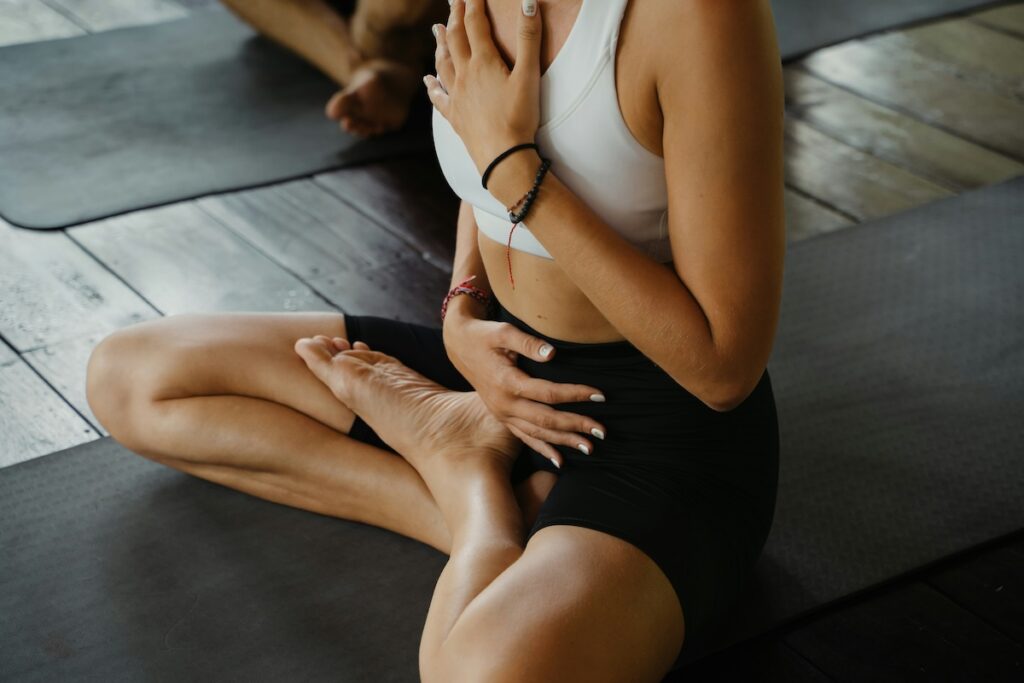
To begin, exhale completely to empty your lungs. Then move through four four-second steps:
- Step One: Inhale slowly through your nose for four seconds.
- Step Two: Hold the air in your lungs for four seconds.
- Step Three: Exhale for four seconds.
- Step Four: Hold with empty lungs for four seconds.
Completing all four steps is considered one Box Breathing circuit. Divine recommends committing to a 10-20 minute dedicated practice session per day and supplementing with single circuits throughout the day when time allows.
Adjust As Needed
Not everyone is at the fitness level of a Navy SEAL, nor does everyone have the same breath capacity. Controlling breaths for four counts as necessary for Box Breathing won’t necessarily be a breath in the park for the unpracticed. If four-second circuits are too challenging, it is reasonable to build up to it (e.g., two- or three-second circuits).
Why Box Breathing Works
Box Breathing engages the vagus nerve, the tenth cranial nerve and the longest of the cranial nerves, which carries both motor and sensory signals and influences several organ systems. By using Box Breathing to lower your heart rate, your nervous system can respond in kind, signaling to the brain that the stress you feel doesn’t need an adrenaline response or the like.
Ultimately, Box Breathing, among other breathing techniques, is a tool to help manage stress perception. Even if an environment or situation is stressful, how you perceive it can influence how much that stress affects you.
The Takeaway
Box Breathing can be a useful tool to lower your heart rate, thereby reducing the stress you feel. One circuit is 16 seconds total — four four-second phases: inhale, hold, exhale, hold.
To try more breathing techniques, sign up for our free seven-day course.
Ready to go beyond box breathing? Our seven-day breathwork course covers the techniques that calm your nervous system in just a few minutes a day.